
A survey template earns its keep only if you can copy it straight onto your site without writing a single question from scratch.
Three things have to be on the page for that to work: the exact question wording, the answer format for each question, and the moment you send it. Miss one and you’re writing the survey yourself, which is how sites end up shipping questions nobody can act on.
You get eight finished sets, 75 questions in total, for the people using your site, the clients you invoice, the customers who just bought from you, the guests who just checked out, and the person who opened a support ticket. Every question carries its answer format beside it and a note on when to send it, so nothing is left for you to decide except which set you need. Start with the user satisfaction survey template that gives this page its name, or go straight to whoever you most need to hear from.
Table of Contents
- Why Copy a Survey Template Instead of Writing One
- Survey Question Formats You’ll See in These Templates
- 8 Survey Templates by Audience
- How to Turn Any of These Templates Into a Live Survey
- FAQs About Survey Templates
Why Copy a Survey Template Instead of Writing One
Writing survey questions is the part that stalls people. It is easy to end up with five questions that all circle the same thing, or one that quietly tells the reader what answer you want. Starting from a finished set skips that, and it means the survey goes out this week rather than whenever you next clear an afternoon.
How long a survey can run depends on the moment it arrives: a survey that interrupts someone mid-task has to be short, because you’re borrowing attention from whatever they came to do. A survey that arrives by email after a project wraps up, an order lands, or a stay ends can be much fuller, because the person opening it has already agreed to give you a minute. The sets below run from eight questions to ten, and each one tells you where it fires and why.
The sets are grouped by who you’re asking. Swap in your own product or category name as you go, and you have something you can build in minutes. Where a list needs your own products or brands, a worked example shows the shape to copy.
One set is the exception to that grouping. Everyone who lands on your site is a visitor before they are a customer, a client, or a guest, so the website feedback set asks about the site itself rather than about the person answering. And if you’d rather browse by survey type than by audience, our roundup of online survey examples covers the same ground from the other direction.
Survey Question Formats You’ll See in These Templates
Every question in every set below has its answer format in square brackets after it, like [Star rating] or [Long answer]. These are the standard survey answer formats, not shorthand invented for this page, so a set you copy here will map onto whatever survey tool you already use.
Seven formats cover all eight sets:
- Star rating handles every 1 to 5 score. One tap, no typing, and a number you can compare week to week.
- Radio buttons are for questions with exactly one answer, including any scale worded in words rather than numbers.
- Checkboxes are for questions where several answers are fair at once.
- Single text field collects a word or a name.
- Long answer is for the questions where you want someone to talk.
- Email capture asks permission to reply, and always sits last.
- Net Promoter Score is the 1 to 10 recommendation question. It appears in three sets here: website feedback, client satisfaction, and help desk.
There is no “multiple choice” format. Survey tools split that idea into Radio buttons and Checkboxes depending on whether one answer or several make sense. If you want the fuller picture before you start, our guide to the types of survey questions covers what each one is good for, and our breakdown of Likert scale examples and questions is worth a look before you write any scale of your own. Every format named above is available in UserFeedback, the WordPress survey plugin used for the screenshots on this page.
Don’t have a survey builder yet?
Any set on this page can go live on your site with one dropdown pick per question, and there is a step-by-step walkthrough further down if you want to see how one goes from copied text to a live survey.
8 Survey Templates by Audience
The person you are asking changes the questions more than anything else does: a client judges how you work, a guest judges a stay, a support customer judges how much effort the whole thing cost them. Clients get two sets, one for the end of a project and one for the middle of a retainer. Pick the one that matches who you’re asking and ignore the rest.
User Satisfaction Survey Template
This set follows a whole visit from start to finish: it asks what someone came to do, whether they managed it, and how hard the site made it.
It opens with a rating so nobody has to type before they’ve committed. The two open questions come near the end, once the person is already invested, with only the contact field after them.
Here are the nine questions, in the order we’d ask them:
- How would you rate your overall experience on our site today? [Star rating]
- Which part of the site did you use most today? [Radio buttons] Options: Blog / Pricing / Docs / Support / Somewhere else (swap the first four for your own main sections)
- What did you come here to do today? [Radio buttons] Options: Research something / Compare options / Buy something / Get support / Just browsing
- Did you manage to do it? [Radio buttons] Options: Yes / Partly / No, I gave up
- How easy was it to find what you needed? [Radio buttons] Options: Very easy / Easy / Neither easy nor difficult / Difficult / Very difficult
- Which of these would make the biggest difference to you? [Checkboxes] Options: Clearer pricing / More detail on the product / Easier checkout / Answers to my questions up front / Being able to talk to someone
- What was the most frustrating part of getting that done? [Long answer]
- What were you expecting to find that wasn’t here? [Long answer]
- If we follow up on your answer, where should we reach you? [Email capture]
Send: by email to registered users. On-site, show questions 1 to 4 immediately after someone finishes what they came to do, and keep the rest for email. Nine questions is more than a widget should ask of a visitor who is still mid-task.
Question 4 is what makes the rating readable. A four-star score from someone who gave up halfway is a completely different problem from a four-star score from someone who finished. Without question 4, those two people look identical in your results.
The ease question matters for a different reason. It catches visitors who finished what they came for but found it harder than it should have been, a group that tends to leave without complaining.
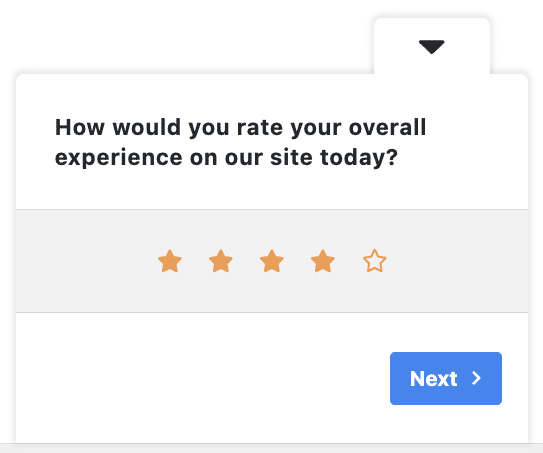
If you only ever run one set from this page, this is the one. It tells you whether your site works, which is the question sitting underneath most of the others. For a longer bank to draw extra questions from, our list of the best user experience survey questions goes deeper on the same ground.
Website Feedback Survey Template
This website survey template works at the level of a single page: it asks what someone makes of the thing in front of them, which means the layout, the navigation, how much detail sits on the page, and whether it feels like somewhere to hand over a card number.
It is also the set with the strongest claim to running on the site itself, because a visitor has to be looking at the page to answer questions about it. That caps how long the on-site version can be, so it comes in two lengths.
Ten questions, for a site you want judged properly:
- How would you rate the look and feel of this website? [Star rating]
- How easy is it to find your way around? [Radio buttons] Options: Very easy / Easy / Neither easy nor difficult / Difficult / Very difficult
- Which of these best describes the page you’re on? [Radio buttons] Options: Exactly what I needed / Useful but incomplete / Interesting but not what I wanted / Not useful / Confusing
- Is there enough detail on our pages? [Radio buttons] Options: Far too much / A bit too much / About right / Not quite enough / Nowhere near enough
- How well does the site work on the device you’re using? [Radio buttons] Options: Very well / Well / Neither well nor badly / Badly / Very badly
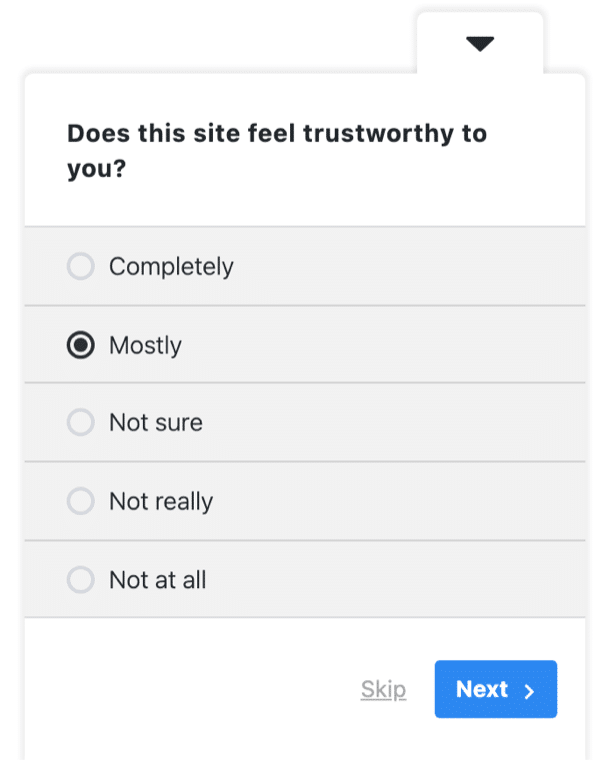
- Does this site feel trustworthy to you? [Radio buttons] Options: Completely / Mostly / Not sure / Not really / Not at all
- If you could change one thing about the design, what would it be? [Long answer]
- Which of these would improve the site most for you? [Checkboxes] Options: Clearer navigation / Simpler layout / More images or video / Shorter pages / More examples / Better mobile layout
- How likely are you to recommend this site to someone looking for what we do? [Net Promoter Score]
- If you’d like a reply about anything you’ve raised, where should we send it? [Email capture]
Send: questions 1 to 3 as a widget on the pages you want judged, and the full ten by email to registered users or your list. Keep the three-question version around even if you run the full set by email, because website feedback is the rare case that benefits most from sitting on the page being rated.
Question 6 is worth keeping even when you trim the set, because trust decides whether a visitor buys from you and nothing else here asks about it directly.
Question 3 covers your content without turning this into a content survey. If answers cluster on “useful but incomplete” you have a depth problem on particular pages, and our walkthrough of a did you find this page helpful survey measures that page by page.
A site that behaves on a laptop can be unusable on a phone, and the visitors worst affected are the least likely to stop and tell you. That’s what question 5 is listening for.
Question 7 comes after the scored questions on purpose. By the time someone has rated the look, the navigation and the detail, they have worked out what actually bothers them, and the answer arrives specific instead of vague.
The Net Promoter Score question at number 9 asks one thing on a 1 to 10 scale: how likely is this person to recommend you. Collecting the score comes with Plus. The report that turns those scores into Promoters, Passives, and Detractors and tracks them over time is a Pro feature.
For the wider picture on what to do with the answers, our guide to website feedback covers collecting and acting on it beyond a single survey.
Client Feedback Survey Template (End of Project)
This set asks about the working relationship month to month, which is where the friction that eventually loses a client builds up.
This set is written for agencies, freelancers, and service businesses, so it asks about the process rather than the product. It also asks why they hired you.
These ten questions work as a project wrap-up survey, sent by email rather than shown on your site:
- How would you rate working with us on this project? [Star rating]
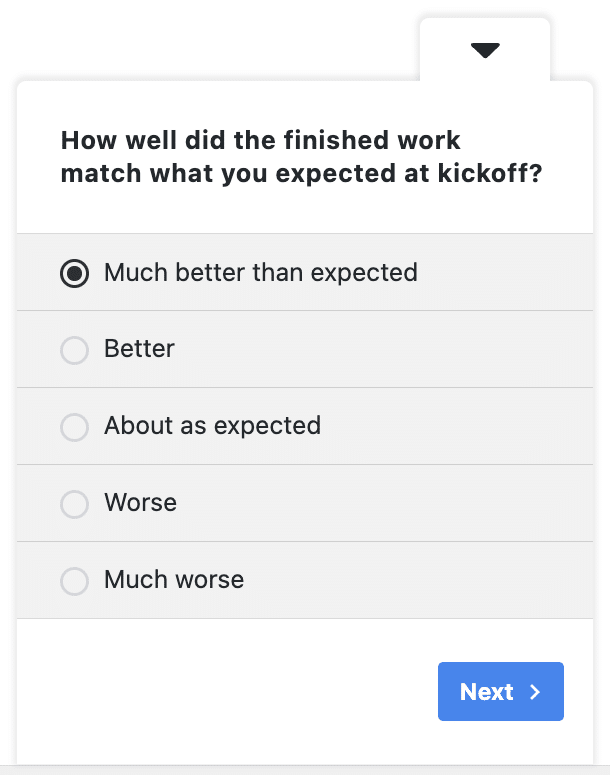
- How well did the finished work match what you expected at kickoff? [Radio buttons] Options: Much better than expected / Better / About as expected / Worse / Much worse
- How easy were we to work with day to day? [Radio buttons] Options: Very easy / Easy / Neither easy nor difficult / Difficult / Very difficult
- How clear was our communication while the work was underway? [Radio buttons] Options: Always clear / Mostly clear / Sometimes confusing / Hard to follow
- Which part of the process felt slowest to you? [Radio buttons] Options: Kickoff / Feedback rounds / Approvals / Final handover / Nothing felt slow
- What made you choose us instead of the other options you looked at? [Long answer]
- What one thing would have made this project go better? [Long answer]
- What could we add to what we do that you’d genuinely pay for? [Long answer]
- How likely are you to refer us to someone else? [Radio buttons] Options: I already have / Very likely / Possibly / Unlikely / No
- Where should we send our follow-up questions? [Email capture]
Send: by email within two working days of the final handover, while the detail is still fresh. A wrap-up survey is the easiest kind to run long, because the client has just finished working with you and has something to say.
Question 8 asks what a client would pay for that you don’t currently sell. The answers name services they are buying somewhere else, which is worth more than the rating in question 1. If you want more to choose from, our guide to customer survey questions has a wider bank you can borrow from.
Answers to question 2 stop you misreading everything else. Expectations set at kickoff shape how the finished work lands, which is why questions 2 and 5 ask about the process and the outcome separately.
Client Satisfaction Survey Template (Monthly)
The set above is for the end of a project. This shorter one is for the middle of a relationship, when you want a number you can watch rather than a story.
It leads with the same Net Promoter Score question the website set uses, because a recommendation score you collect every month becomes a trend you can watch. The score itself collects on Plus; the report that tracks Promoters and Detractors over time is Pro. If you’d rather work the number out by hand first, here’s how to calculate an NPS score.
Here’s a sample client satisfaction survey, eight questions long. It still takes a client under two minutes:
- How likely are you to recommend us to another business like yours? [Net Promoter Score]
- How satisfied are you with the results we’ve delivered so far? [Star rating]
- What’s the main reason for that answer? [Long answer]
- How easy is it to reach us when you need something? [Radio buttons] Options: Very easy / Easy / Neither easy nor difficult / Difficult / Very difficult
- How do you feel about the value you get for what you pay? [Radio buttons] Options: Excellent value / Good value / Fair / Poor value
- How confident are you that we’re focused on the right priorities? [Radio buttons] Options: Very confident / Fairly confident / Not sure / Not very confident / Not at all confident
- Which of these describes your plans with us for the next year? [Radio buttons] Options: Carry on as we are / Expand the work / Reduce the work / Bring it in-house / Not sure yet
- What’s one thing we could do better next month? [Long answer]
Send: by email at the end of a retainer month, so the score lands often enough to become a trend.
Treat question 7 as an early warning. If a client rates you four stars and picks “Bring it in-house”, have that conversation now instead of waiting for the renewal date.
Question 6 asks whether you are working on the right problem, which is separate from whether the work was good. Doubt about direction appears here months before it appears in question 7.
When question 7 does come back bad, questions 4 and 5 usually explain it. Slow replies and a sense of overpaying erode a retainer more than any single piece of work.
Customer Questionnaire Template (With a Short Customer Survey)
A questionnaire and a satisfaction score answer two different questions, and a survey that mixes them answers neither well.
This set is the questionnaire: who your customers are, how they found you, what they nearly did instead, and what they wish you sold. Nothing in it produces a score to average, so you read the answers rather than chart them.
It doubles as a customer survey template at two lengths. Sent by email a couple of weeks after an order, run all ten questions. If you want something on an order confirmation page instead, use questions 1, 5 and 6 on their own, because a page someone reaches at the end of checkout is no place for a ten-question survey.
If what you actually want is a number you can track over time, that’s a different kind of survey with different wording. Our guide to customer satisfaction survey examples and templates covers those scored versions properly, including how to phrase them and what to do with the results.
Here’s the questionnaire, ten questions long:
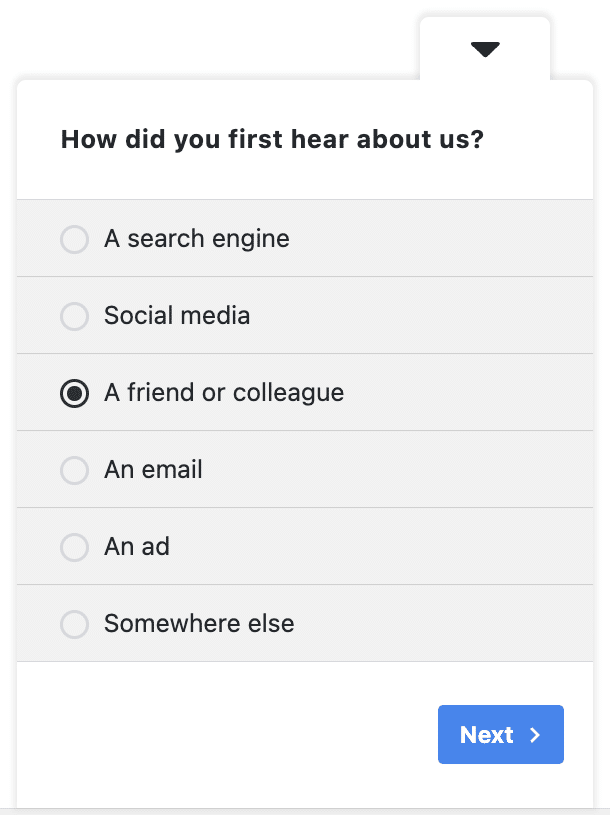
- How did you first hear about us? [Radio buttons] Options: A search engine / Social media / A friend or colleague / An email / An ad / Somewhere else
- Who else were you looking at when you found us? [Single text field]
- How long were you looking before you decided? [Radio buttons] Options: The same day / A few days / A few weeks / Months
- What were you trying to solve when you found us? [Long answer]
- How easy was it to work out whether we were right for you? [Radio buttons] Options: Very easy / Easy / Neither easy nor difficult / Difficult / Very difficult
- What nearly stopped you from buying? [Long answer]
- Which of our products or services do you use most? [Radio buttons] Options: Starter plan / Pro plan / Add-ons / Support retainer / Something else (swap the first four for your own products)
- What else do you buy alongside what you get from us? [Checkboxes] Options: Hosting / Design services / Email marketing / Training / Nothing else (swap the first four for whatever sits alongside what you sell)
- What would make you buy from us more often? [Long answer]
- What’s one thing you wish we sold that we don’t? [Single text field]
Send: by email about two weeks after a first order, once the customer has actually used what they bought.
Question 6 earns its place because a near-miss on the purchase names something specific you can fix, often a single page.
Questions 2 and 5 pay off as a pair. The first tells you who you were actually measured against, and the second tells you how hard you made that comparison. Neither is a satisfaction score, and both change what you put on a page.
Question 1 also shows why the option list has to stay short. A long one is more likely to be skimmed than read.
Consumer Survey Questionnaire Template
A consumer survey asks people about a category and their habits inside it, not about you.
That makes it the right survey to run before a launch, or when you’re deciding how to price something, and the people answering don’t need to have bought from you at all.
These nine questions cover buying behavior and brand perception:
- When you think of [your category], which brand comes to mind first? [Single text field] Worked example: “When you think of running shoes, which brand comes to mind first?”
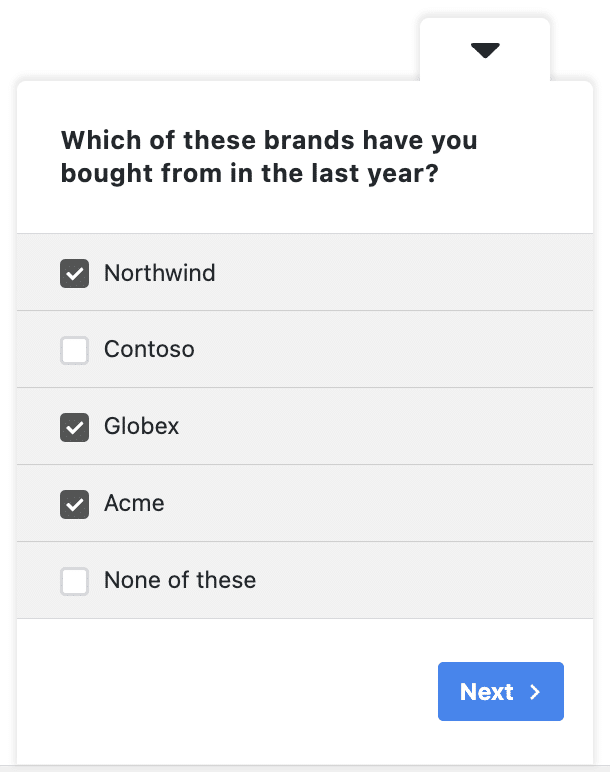
- Which of these brands have you bought from in the last year? [Checkboxes] Options: Northwind / Contoso / Globex / Acme / None of these (the four example brands are placeholders, and the screenshot below shows them; swap in your own name and the brands you compete with)
- How often do you buy something in this category? [Radio buttons] Options: Weekly / Monthly / A few times a year / Once a year or less / Never
- What matters most to you when you pick a brand in this category? [Radio buttons] Options: Price / Quality / How it’s made or sourced / Convenience / Reputation
- How easy is it to tell these brands apart? [Radio buttons] Options: Very easy / Easy / Neither easy nor difficult / Difficult / Very difficult
- Where do you look before you buy something like this? [Checkboxes] Options: Search engines / Review sites / Video reviews / Social media / Friends and family / In a store
- What would you expect to pay for something like this? [Radio buttons] Options: Under $25 / $25 to $49 / $50 to $100 / Over $100 (move the bands so they bracket your own price)
- What would make you switch from the brand you use now? [Long answer]
- What do you wish someone in this category would offer that nobody does? [Long answer]
Send: by email to your list. At nine questions it is too long for a widget on a category page, where people are still browsing. If you do want it on-site, run questions 3, 4 and 7 there and keep the rest for email.
Question 1 is a free brand-awareness study. If your own name almost never comes up on your own site, the problem is how people see you, and no amount of improving the product will fix it.
Comparing question 1 against question 2 shows the gap between the brand people recall and the brands they actually buy.
Question 3 exists so you can weight the rest. An answer from someone who buys weekly should not count the same as an answer from someone who buys once a year, and without it you cannot tell them apart. A survey is only one input here, so it is worth pairing with qualitative research if you’re sizing a launch.
Guest Satisfaction Survey Template
Hospitality feedback has a short shelf life. A guest who was annoyed about the check-in queue will have forgotten the detail by the time your email arrives a week later, and all you’ll get back is a number.
This set is written for hotels, rentals, venues, restaurants, and anywhere else a visit is the product. At ten questions it is built for the morning-after email rather than the checkout desk, while the guest has time and the stay is still fresh.
Here’s the sample, ten questions for the end of a stay or a visit:
- How would you rate your stay with us overall? (for a restaurant or venue, swap “stay” for “visit”) [Star rating]
- How would you rate the cleanliness of the room or space? [Star rating]
- How easy was checking in and out? (where there is no front desk, ask “How easy was booking and arrival?”) [Radio buttons] Options: Very easy / Easy / Neither easy nor difficult / Difficult / Very difficult
- Which part of your visit stood out for the right reasons? [Radio buttons] Options: Check-in / The room / Food and drink / The staff / The location / Something else
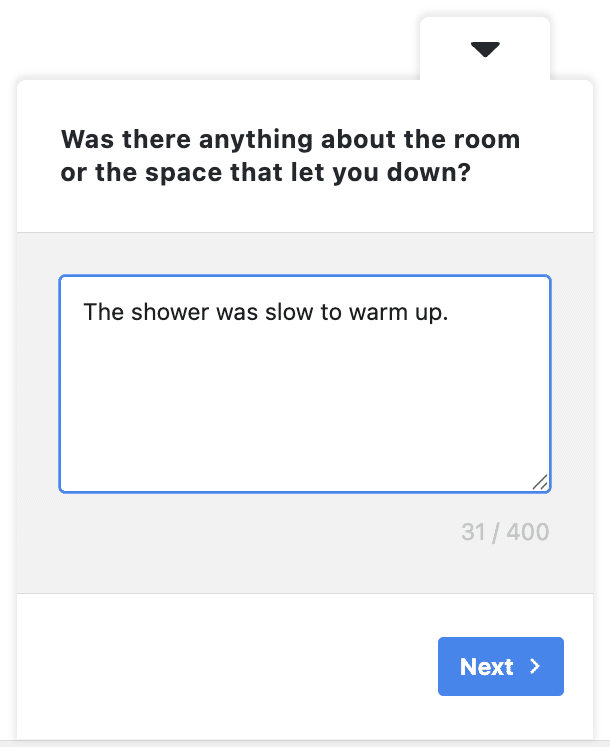
- Was there anything about the room or the space that let you down? [Long answer]
- If you ate with us, what would you add to or take off the menu? [Long answer]
- How did you feel about the value for what you paid? [Radio buttons] Options: Excellent value / Good value / Fair / Poor value
- How likely are you to book with us again? [Radio buttons] Options: Definitely / Probably / Not sure / Probably not / Definitely not
- What one thing would have made your stay better? [Long answer]
- If you’d like a reply about anything you’ve raised, where should we send it? [Email capture]
Send: by email the morning after checkout, which is where a set this length belongs.
Question 5 is worded as a let-down rather than a complaint on purpose. People who won’t say “I have a complaint” will happily say what disappointed them, and it’s the same information.
Question 2 asks about cleanliness on its own. A guest who found the room unclean will not be reassured by anything else in the stay.
Question 7 asks about value, which is a different judgment from quality and the one that decides whether a guest books again.
Question 6 is worth keeping even if food is a small part of what you do. Menu answers arrive as specific suggestions rather than scores, and they are the easiest thing on this list to act on next week. Guests are a hard audience to get replies from, so it’s worth reading up on how to increase your survey response rate before you send it.
Help Desk and Support Survey Template
This set measures what the whole thing cost the customer, alongside how the agent handled it.
Questions 3 and 4 cover the cost side: how long the resolution took from the customer’s side, and how many times they had to re-explain.
The set is ordered so resolution comes first, since effort and agent performance only matter once you know whether the issue was actually fixed.
Nine questions, sent once per resolved ticket:
- Did we fix what you contacted us about? [Radio buttons] Options: Yes, completely / Partly / No / I’m still waiting
- How did you contact us? [Radio buttons] Options: Email / Live chat / Phone / A form on the site / Social media
- How long did it take to get this resolved, from your side? [Radio buttons] Options: Under an hour / The same day / Two or three days / About a week / Longer than a week
- Did you have to explain your problem more than once? [Radio buttons] Options: No / Twice / Three or more times
- How much effort did this take on your side? [Radio buttons] Options: Almost none / A little / A fair amount / Far too much
- How would you rate the person who helped you? [Star rating]
- How satisfied are you with the way this was handled overall? [Star rating]
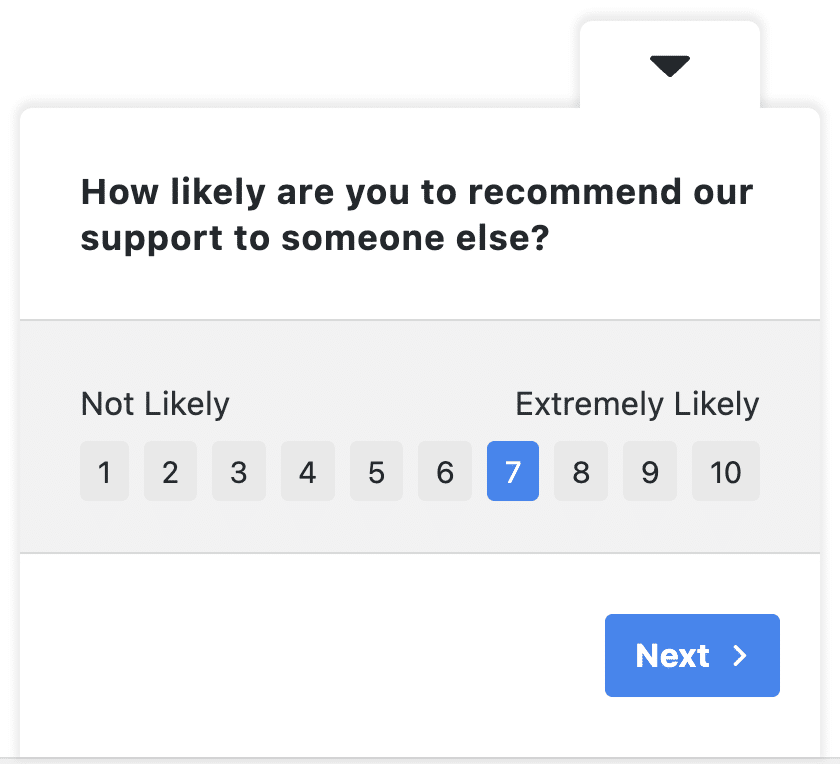
- How likely are you to recommend our support to someone else? [Net Promoter Score]
- What would have made this faster for you? [Long answer]
Send: by email immediately after the ticket is marked resolved, not in a monthly batch. A resolved ticket is the one moment a customer will happily answer nine questions, because you have just finished helping them.
The pattern to watch for is question 6 scoring well while question 5 scores badly. That combination means your team is good and your process is broken.
Question 4 usually tells you why. Repeating the same explanation is what makes a support experience feel expensive, and the fix is in the handover between agents.
Your ticket system already times itself, but question 3 asks for the customer’s sense of how long it took, which is what reaches a review even when the ticket log says otherwise.
Question 2 keeps the rest honest. Effort and waiting time mean very different things on live chat and on email, and without it you are averaging two unrelated experiences.
Question 5 is a Customer Effort Score question in everything but name, and it is worth running as its own tracked metric once this set is live. We have a walkthrough for building a CES survey in WordPress, and a wider bank of customer service survey questions if you want to extend the set.
How to Turn Any of These Templates Into a Live Survey
If you don’t already have a survey tool, the good news is that UserFeedback can build every set on this page. The whole build happens inside your WordPress admin: there’s no separate survey platform to sign up for and nothing for a developer to wire up.
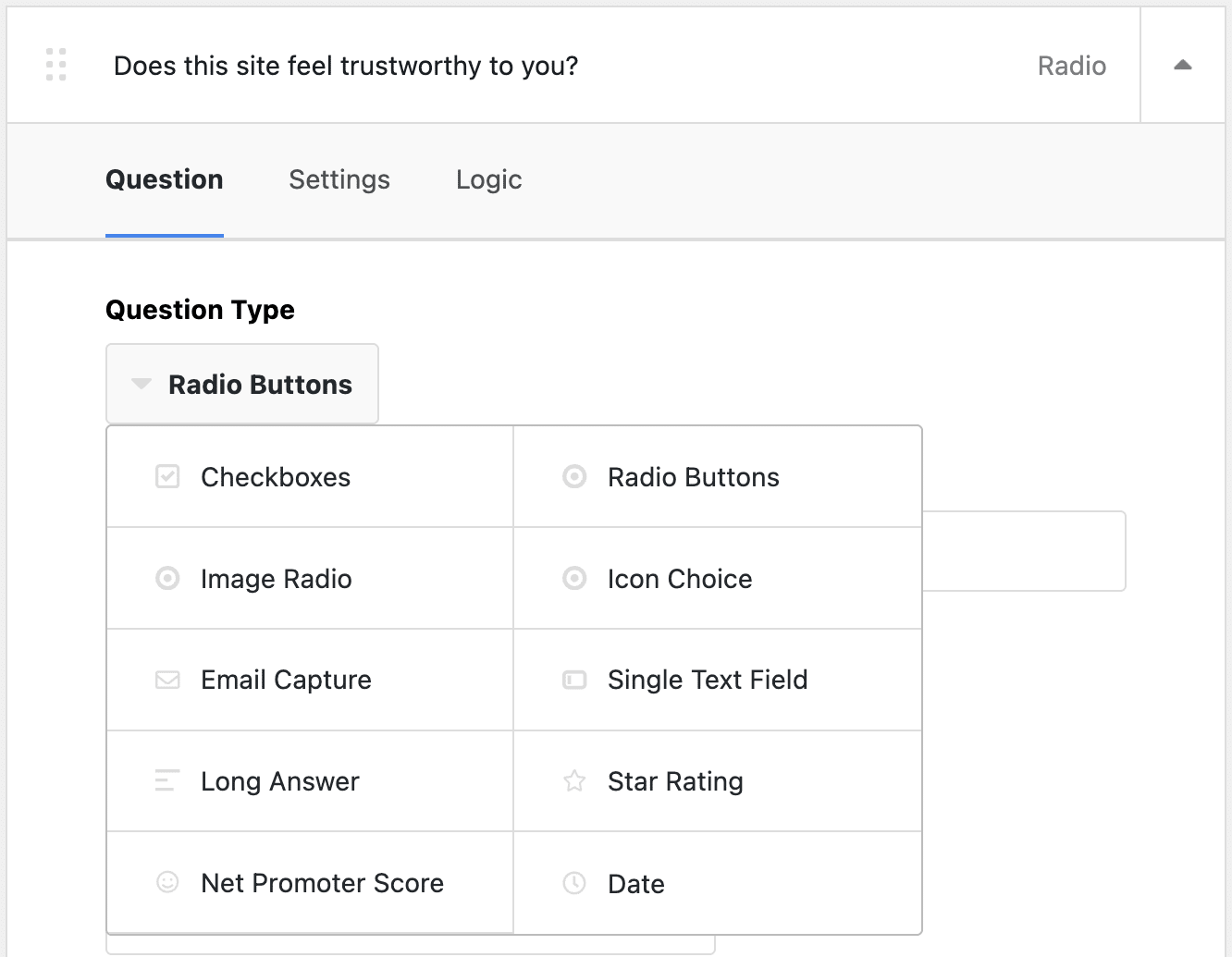
The bracketed labels map straight onto the Question Type dropdown, so copying a set is mostly a matter of picking the right format for each line.
All Question Types come with Plus, along with the library of 20+ premium templates. If you’d rather edit something than start with a blank survey, Website Feedback is the template we’d open first.
In your WordPress admin sidebar, open UserFeedback, then click Create New above your survey list.
From there you can choose Start from Scratch, or load a template from the library and change it. Either way you land in the same editor, where you click into the question text to replace it with the wording you copied from this page.
Use Add Question for every question after the first, and pick its format from the Question Type dropdown. That dropdown is where the bracketed labels in this article come from, so a set you copied here maps onto it one for one. If you’d rather follow a screenshot for every screen, our step-by-step guide to creating a survey in WordPress walks through the whole build.
Once the questions are in, the rest of the build is settings.
Thank You Message decides what a respondent sees after they submit, either a short message or a redirect. Settings holds Targeting and Behavior, Notifications emails you each response as it arrives, and Survey Summary is where you publish or schedule the survey.
Surveys display on all pages by default, at the bottom right of the browser, and on every device: desktop, tablet and mobile are all switched on until you say otherwise. Narrowing that to particular devices is what Device Targeting adds on Pro.
The alternative to the widget is a shortcode, which embeds the survey inside a page like any other content. That suits the customer questionnaire and the consumer set better than a pop-up does. Every survey gets its own shortcode: go to UserFeedback » Surveys, click the shortcode to copy it, then paste it where the questions belong. A pasted shortcode also overrides the widget position settings, so the survey sits exactly where you put it rather than in the corner.
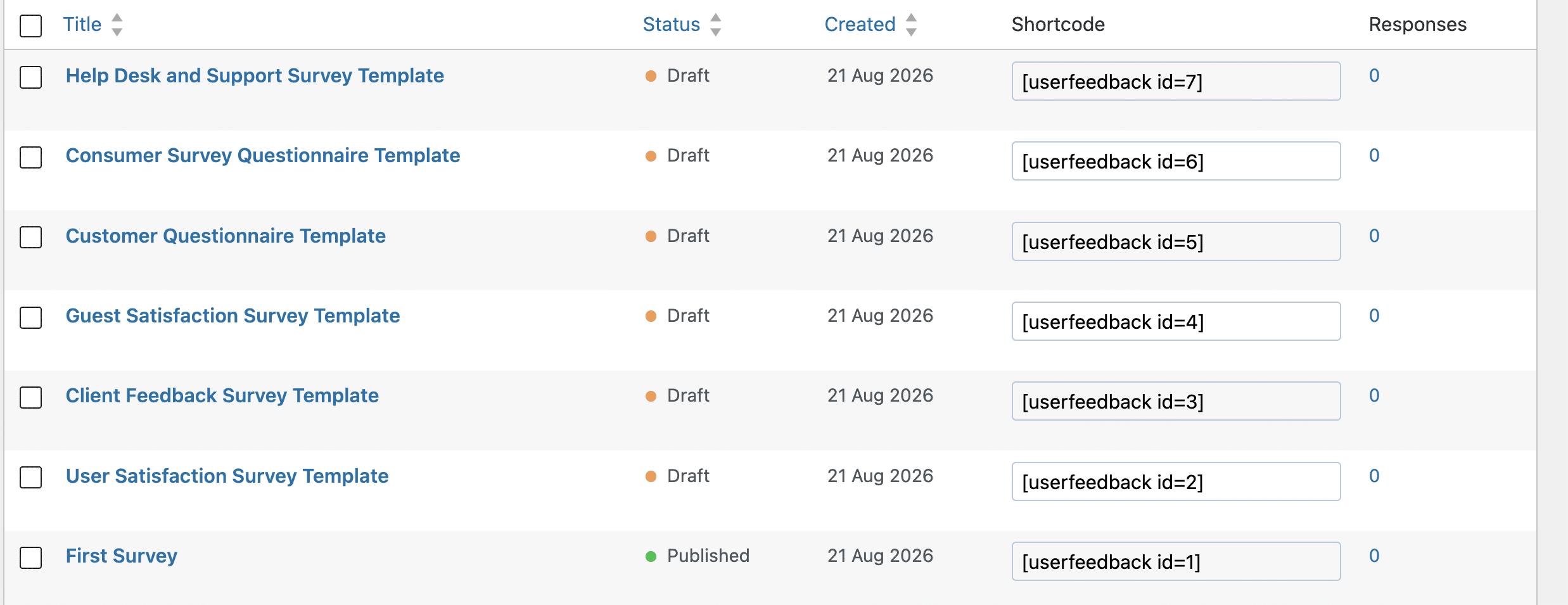
Once it’s pasted, the survey behaves like part of the page, which tends to get better completion on long pages than a floating widget.
Where a survey appears is a separate decision from what it asks. Page-Level Targeting is part of Plus, so a short on-site survey can run only on the pages it belongs to, rather than following visitors around the whole site.
The three-and-four question versions in the notes above are the ones to put on a page; the full sets belong in an inbox, where nobody is being interrupted.
Getting a set into an inbox works two ways. For the full eight-to-ten question sets, paste the survey’s shortcode onto a page you keep out of your navigation, then link that page from the email you send with whatever tool you already use. For a single question, the Email Surveys addon puts it inside the email itself, so subscribers answer in one click without leaving their inbox and the responses still land in your dashboard.
Device Targeting, Geo Restrictions, and Schedule Surveys are Pro features, as is the NPS report. The 1 to 10 question itself comes with Plus. Scheduling is the one to check first if you’re running the guest set around a seasonal booking window.
UserFeedback is built for surveys and feedback, not for contact or lead-capture forms. The Email capture question exists so you can follow up on an answer, not so you can run your sign-up flow through a survey.
So the build comes down to one dropdown pick per question and one decision about where the survey shows.
That’s the case for copying a finished set instead of opening a blank survey: the wording was the slow part, and skipping it means answers start arriving this week rather than whenever you next clear an afternoon.
Ready to put one of these live?
The walkthrough covers the whole build in UserFeedback, with a screenshot for every screen. Each question needs one answer format chosen from a dropdown, plus one decision about where the survey appears.
FAQs About Survey Templates
What makes a survey template worth using?
A usable template gives you the exact question wording, the answer format for each question, and a point in time to send it. If it only gives you topics to cover, you’re still writing the survey yourself. Every set on this page clears that bar.
How many questions should a survey have?
It depends where it fires, not on a single rule. Keep it to three or four questions when it interrupts someone mid-task on your site, because you’re borrowing attention from whatever they came to do and a visitor who didn’t ask to be surveyed will close anything that looks like work. Eight to ten is fine when the survey arrives by email after a project, an order, a stay, or a support ticket, where the person opening it has already decided to give you a minute. The sets on this page are sized to their trigger, and each one says where it belongs and why.
What’s the difference between a user satisfaction survey template and a website feedback survey?
A user satisfaction survey template asks how the visit went for the person: what they came to do, whether they managed it, and how hard it was. A website feedback survey asks what they make of the site itself: the design, the navigation, whether it feels trustworthy. Run the first when you want to fix journeys, and the second when you want to fix pages. The customer questionnaire is different again, asking about the person and the relationship rather than any single visit.
Which UserFeedback plan do I need to build these templates?
Every set on this page builds on Plus, which includes All Question Types, the 20+ premium templates, and Page-Level Targeting. The one Pro dependency is the NPS report: the 1 to 10 question itself works on Plus, but the report that turns answers into Promoters, Passives, and Detractors over time is Pro. Device Targeting, Geo Restrictions, and Schedule Surveys are Pro as well.
When is the best time to send a survey?
As close as possible to the thing you’re asking about. A support survey belongs on the ticket being resolved, a guest survey in the morning-after email, and a product questionnaire a week or two after delivery. Send it while the experience is fresh, because a month later you are collecting a recollection and recollections drift.
That’s it! I hope this article helped you find a survey template you can copy straight into your site. If you liked this article, check out the following resources:
- Customer Satisfaction Survey Examples & Templates to Use
- Customer Survey Questions + Guide to Meaningful Feedback
- Types of Survey Questions: Complete Guide with Examples
- Employee Feedback Survey Questions That Actually Work
- Patient Satisfaction Surveys: Best Questions & Examples
- Proven Ways to Increase Your Survey Response Rate
And remember to follow us on X and Facebook to learn more about online surveys, questions, and customer feedback.